

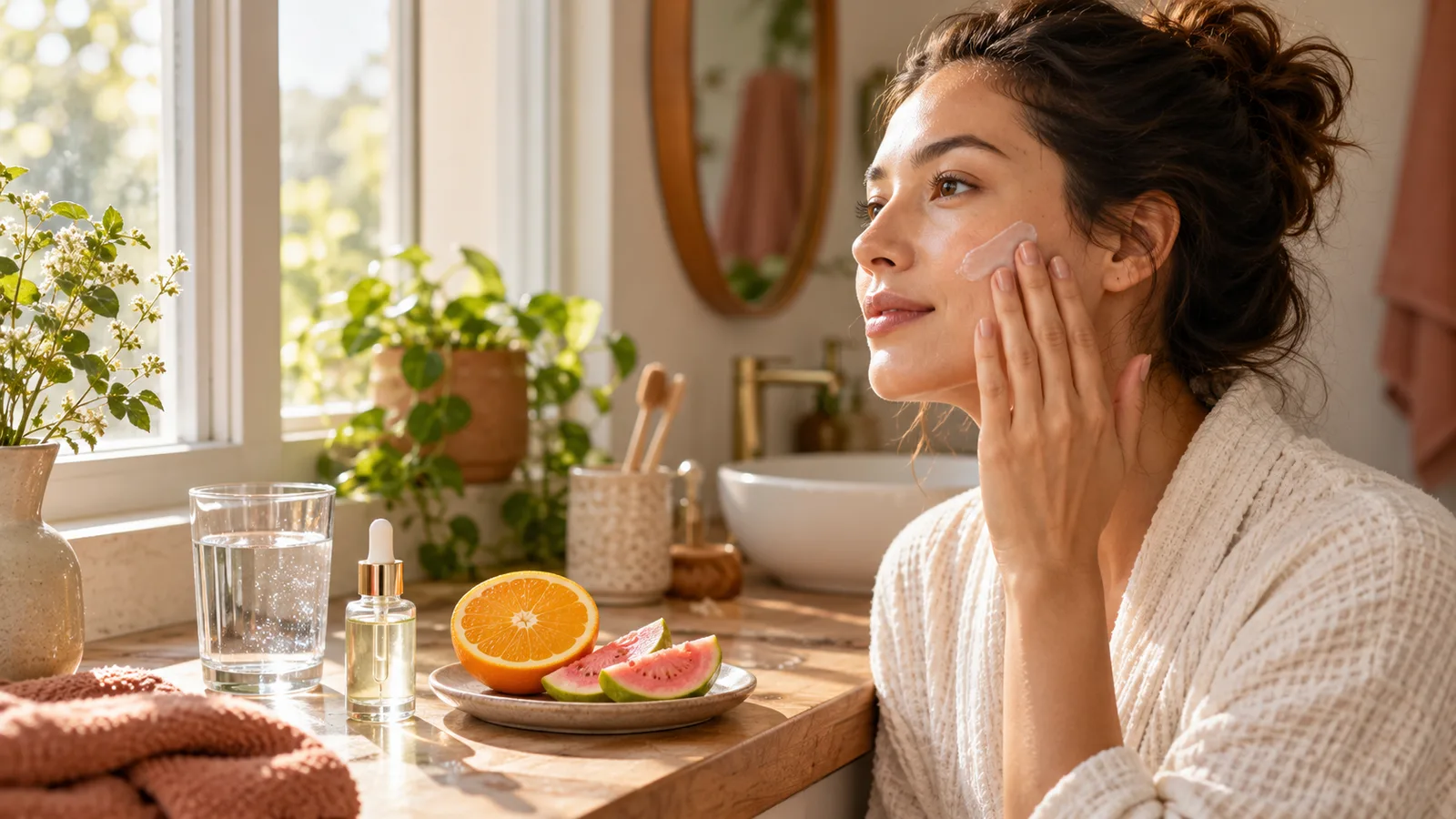
Collagen for the face: consumed, applied, or stimulated through peptides
Collagen for the face can be cared for through three routes: consumed in the form of hydrolyzed collagen, applied through a cream or serum, or stimulated from within the skin with signal peptides such as GHK-Cu. The three work in different ways. Collagen that is consumed supplies raw material and signals through the bloodstream, collagen that is applied maintains moisture at the surface, and peptides prompt skin cells to make their own collagen.
What collagen does for the face
Collagen is the framework of the dermis layer, the part of the skin beneath the surface that provides firmness and suppleness. The type I and III collagen fibers there keep the skin dense, so the face looks firm and fine lines do not form easily. Its production slows with age, and sun exposure also speeds up its breakdown. The basics are covered in the article what collagen is.
Three routes, three ways of working
| Route | How it works | What research observed |
|---|---|---|
| Consumed (hydrolyzed collagen) | Digested into amino acids and short peptides, then circulated through the blood | Skin hydration and elasticity |
| Applied (collagen cream or serum) | The molecule is large, so it works on the skin surface as a moisturizer | Surface moisture and smoothness |
| Stimulated (signal peptides) | Short peptides signal fibroblasts to make collagen | Collagen production and skin firmness |
Collagen that is consumed
Collagen drinks generally come in hydrolyzed form, meaning the collagen has been cut into small peptides so it is easy to absorb. After digestion, peptides typical of collagen such as proline-hydroxyproline are detected in the blood, and laboratory research has observed these peptides signaling fibroblasts, the cells that make collagen. A 2021 review that combined 19 studies with about 1,100 participants observed improvements in skin hydration and elasticity in the group that consumed hydrolyzed collagen, generally over 90 days. A description of the hydrolyzed form is in the collagen peptide guide.
Collagen that is applied
Collagen cream feels moisturizing because collagen binds water at the skin surface. The intact collagen molecule is very large, hundreds of thousands of daltons, so it works in the outermost layer and does not replace the collagen in the dermis. For that reason collagen cream is best seen as a good moisturizer, and its result is felt as skin that is more supple and smooth to the touch.
Collagen that is stimulated through peptides
The third route does not add collagen, but prompts the skin to make its own. GHK-Cu, a copper-carrying peptide first found in human blood plasma in 1973, is the most studied example: laboratory research has observed GHK-Cu encouraging fibroblasts to produce collagen and tidy up skin tissue. Other skincare peptides such as palmitoyl pentapeptide-4 (Matrixyl) work on a similar signaling principle, while argireline has a different role, which is helping to relax expression lines. The full discussion is in peptide benefits for the face.
How to combine them in a routine
- 1
Protect what you already have
Sunscreen every morning keeps collagen from being broken down by UV rays.
- 2
Get enough raw material
Protein from fish, eggs, chicken, or tempeh plus fruit rich in vitamin C such as guava and oranges. The list is in foods that contain collagen.
- 3
Choose an additional route
Collagen drinks, peptide serums, or peptides such as GHK-Cu, according to your needs and comfort.
- 4
Give it time
Collagen turnover in the skin takes place over a matter of months, so a consistent routine matters more than a single use.
Full details of GHK-Cu, glutathione, and other skincare peptides are in the Peptivia catalog. If there is anything you would like to ask before ordering, the Peptivia team is ready to help through Peptivia's official WhatsApp.