

Foods that contain collagen and the nutrients that support its formation
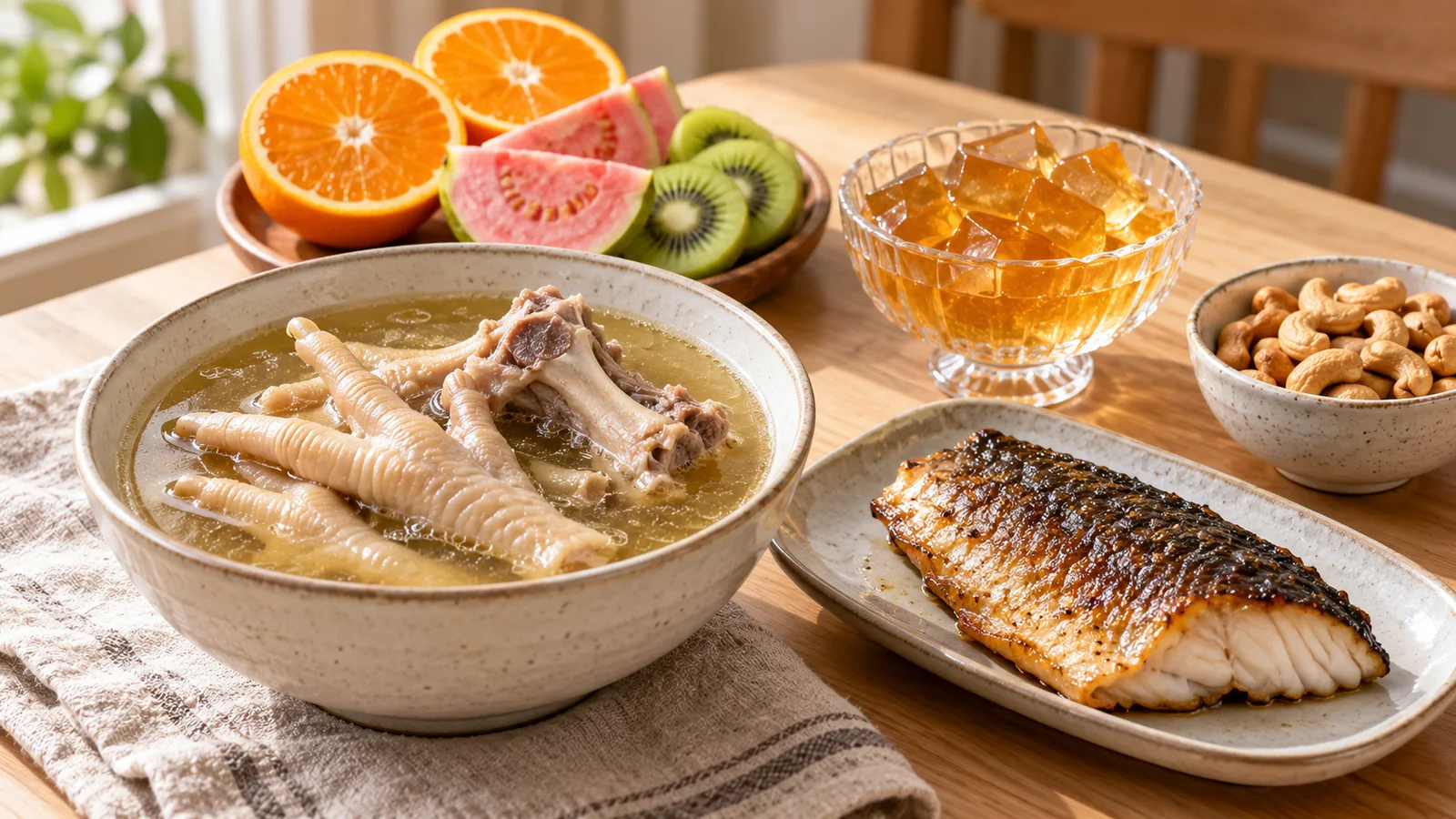
Foods that contain collagen are the parts of fish, chicken, and beef that are rich in connective tissue: skin, bones, cartilage, chicken feet, beef skin and tendon (kikil), and broth that is cooked for a long time. Fruit and vegetables do not store collagen, but they contribute the vitamin C, zinc, and copper the body uses to assemble its own collagen. A diet that supports skin, joints, and bones combines these two groups.
A list of foods that really contain collagen
Collagen gathers in tissue whose job is to withstand pulling, so its level is far higher in the chewy, tough parts than in lean meat. Many of them are already familiar in Indonesian kitchens.
| Food | The part that contains collagen | How to enjoy it |
|---|---|---|
| Beef or chicken bone broth | Bones, joints, cartilage | Simmered for several hours over low heat |
| Chicken feet | Skin, tendons, cartilage | Chicken feet soup, seasoned boiled chicken feet |
| Kikil and oxtail | Skin of the foot and connective tissue | Kikil curry (gulai kikil), oxtail soup |
| Fish with skin and soft bones | Skin, scales, fine bones | Pressure-cooked milkfish (bandeng presto), anchovies, fish head soup |
| Chicken skin and fish skin | The skin layer | Grilled or cooked together with the meat |
| Gelatin | Collagen that has been cooked and purified | Pudding, jelly, chewy candy |
Why long-cooked broth turns jelly-like when cold
Broth that thickens like jelly in the fridge is a sign that the collagen has dissolved into gelatin. Long heating over low heat opens up the twist of collagen's three chains, so the protein is released from the bones and enters the broth. As it cools, gelatin forms a fine mesh that binds water. Adding jointed parts such as chicken feet, oxtail, or knee bones and simmering them longer makes the broth richer in gelatin.
Foods that support collagen formation
The body assembles its own collagen from amino acids, and that process requires several companion nutrients. The stages of assembly are explained in what collagen is; this table summarizes the foods that provide them.
| Nutrient | Its role | Example foods |
|---|---|---|
| Vitamin C | Converts proline into hydroxyproline so the collagen twist is stable | Guava, oranges, kiwi, papaya, bell peppers, broccoli |
| Copper | Used by the enzyme that binds collagen fibers into a sturdy structure | Cashews, beef liver, dark chocolate, seeds and grains |
| Zinc | Supports the enzymes that build and renew tissue | Clams, oysters, beef, pumpkin seeds |
| Complete protein | Provides glycine, proline, and lysine as raw material for collagen chains | Eggs, fish, chicken, tempeh, tofu |
A practical way to combine them: have chicken feet soup or fish with tomato sambal and fresh raw vegetables (lalapan), then finish with pieces of guava or orange. One plate already holds the raw material as well as the vitamin C to assemble it.
What happens to food collagen after it is digested
Collagen from food does not move intact to the skin. Digestive enzymes cut it into amino acids and short peptides, which are then absorbed by the gut. Some peptides typical of collagen, such as proline-hydroxyproline, are detected in the blood after hydrolyzed collagen is consumed, and laboratory research has observed these peptides signaling fibroblasts, the cells that make collagen. An explanation of this hydrolyzed form is in the collagen peptide guide. The other amino acids enter the body's pool and are used wherever they are needed, including to build new collagen.
From the plate to a care routine
Food supplies the raw material, while some people add to their routine with peptides that work as signals. The one most closely related to collagen is GHK-Cu, a copper-carrying peptide whose skin research focuses on collagen production and tissue repair; the discussion is in peptide benefits for the face. For joints and connective tissue, see Cartalax and Klow Blend.
Full details of GHK-Cu, glutathione, and other peptides for skin are in the Peptivia catalog. If there is anything you would like to ask before ordering, the Peptivia team is ready to help through Peptivia's official WhatsApp.